Monday, July 30, 2012

Ode to a shed

I had to tear my shed down this weekend and it brought a tear to my eye. In the interest of full disclosure, I cried at The Hunger Games, each American Girl movie I got suckered into watching, and The Grinch Who Stole Christmas. Every year since 1966, excepting a few when I was a teenager and too cool. I do not, however, normally maintain inordinately fond attachments to inanimate objects. I don’t name my cars. I didn’t think twice about moving from my last home.

 But this house, and this shed, have been different. We settled it in the Fall, a few months later my father died at 64, in a swirl of unfulfilled potential and a few months after that I built a shed, specifically to fulfill a potential.

 Some people have dream homes. I had the dream of owning a home that required the purchase of a small tractor. I am now, and have been for several years, living the dream. Various projects around the house generated excess lumber and the tractor deserved a home of its own, so I decided to construct one. Believing that plans – like those story synopses in operatic playbills – preclude excitement, I set out my wood, purchased some more and started building a shed.

I soon realized that the best way maximize use of my materials and minimize cuts would be to make a cube. 10 x 10 x 10. This would result in an object of beauty, a pantheon to originality. With a flat roof. I live on an island north a Buffalo, NY. If you are not familiar with the climate of the northeastern Americas, let my just say, most people prefer a roof that encourages snow and rain to slide to the side. I liked the cube, so rather than form a peak, I decided to cant the whole building.

I loved this design. Bold. Unique. I didn’t even mar it with a door. I fashioned a secret panel, with a catch hidden in the bottom. The shed stood like a brown monolith, as if Kubrick had decided to do a woodsy version of 2001 A Space Odyssey. Yes, the roof sagged and I had to install center supports, which barely left room for the tractor. And yes, it leaked like disgruntled middle managers, passed over yet again. Still, a big nut-color cube? Look at it. Moisture, mold, mice, followed by squirrels and squishy floorboards. After eight years of patching, caulking and burning time I didn’t have, came the saw and the sledge. There was nothing else to do. My lesson in classic tragedy. Fixing the flaws would have destroyed the reasons I cherished the shed in the first place.

It’s also my lesson in perseverance. Next time, I’m going to do it right. I’m thinking pyramid.

Wednesday, July 18, 2012

The Long Walk reading

Going to see Brian Castner at Talking Leaves (Main St.) tonight at 7.  This guy is fascinating and this book is superb.

Monday, July 2, 2012

StrayScore


As a species we’ve been ranking books since there were two.  One is always better or worse than the next, but that never told the whole story, so we invented genres.  Cubby-holes into which we can shove titles, twisting, bending or ignoring the fact that a few should be in several places at one time. (An unacceptable state for any bookstore or library.  There’s no quantum Dewey decimal system.)  And that leads to StrayScore – a method for rating novels based not on quality or content, but on how far they depart from reality.

Every novel requires suspension of disbelief.  How much marks a difference that transcends genres.  There are novels based firmly in reality.  The characters act as one might expect, going about their lives on planet earth, depicted with language you can easily comprehend.  Then there are novels in which multi-phase energy clumps blink light poems in a time and place outside of time/space.  The majority of most novels fall in between.  StrayScore takes the traditional parts of a novel (theme, problem, plot, character, setting, style) and asks you to rank how far from normalcy the author has stretched.  The total of the rankings produces a final score for the book.

And for you.  While most open-minded readers are capable of appreciating anything written well, by scoring novels you hold dear, a personal preference emerges.  When it comes to the novels we love, we all have a score.  Like one of those adjustable air mattresses.  Some of us like novels with a little bit of speculation, whether it be a glimpse of a ghost, the entrenchment of a dystopian society or a murder solved and killer stashed away for life without parole.  Once you know how much disbelief you like to suspend, StrayScore can help you find novels you might love, regardless of their place on the shelves. 

StrayScore is about you and novels, and you and novels.  The more people participating, the better it works.  Please visit, sign up, vote on books listed, add books not yet vetted and tell us what you think.

Tuesday, June 12, 2012

Tony Awards

The Tony Awards is consistently the best produced awards show on television. There isn’t really a second place. It should be expected, I supposed. Putting on a show is what these people do for a living. If the Academy Awards was a film, I’m certain it would be way more watchable. The Golden Globes should be reality show and there is simply no hope for the Grammy’s. (You can’t have old people comparing apples, lemons and ugly fruit expecting to get an acceptable spectacle.)

Neal Patrick Harris hosted this year’s show. He also produced. He should receive an Emmy for smashing the last 66 years-worth of song winners into one show-stopper, let alone his service to the rest of the production. And as long as he’s going to be at the Emmys, the Academy of Television Arts & Sciences should ask him to host.

Of course, I’m not being completely fair. Part of the reason I love the Tonys is that I have no stake in the outcome. I don’t get to see Broadway plays. I do watch movies, too much TV and listen to all kinds of music. I can’t help but have opinions, opinions that do not match those of the various voting bodies. It’s frustrating. Thank God they don’t televise the Booker Awards, Nebulas or Nobel Prizes in Literature. I’d be chucking mint Milanos at the TV all night.

I relax by not caring.  Surprised more people don't.  So for now, I’ll enjoy the Tony Awards. Until I write a play. Then I’ll hate those too.

Tuesday, May 29, 2012

Galapagos Backup

I told Nina, my 11-year-old, how important it is to backup your work. She put hours and hours into her Galapagos report and saved it once, to her flash drive. I could see all her paths to disaster, because I’d been down them.

Several (many) years ago I wrote a screenplay reworking Sleeping Beauty in a post-apocalyptic world. Pretty much done, it sat on my hard drive as a storm struck. Boom. Lighting. Surge. All those things somebody warned you might happen if you didn’t unplug your electronics – those things that are so foreign they couldn’t possibly, actually happen - happened to me. Lost the whole drive, project and all.

Nina agreed that I should back everything up. So I slid the desktop file to the flash. Yep. Exactly backwards. Vaporized four hours of her work. While it was nice outside. While kids rode bikes and swam. Four hours of 11-year-old homework, which is like 40 hour to you and me. Gone. Along with any tone of authority I might have had, any sense that I was helpful in anyway. Lessons, respect, confidence – erased in 21-first-century manner, leaving no rub marks, impressions or little black rolls of goo to be blown off the page with a gentle puff.

Puff.

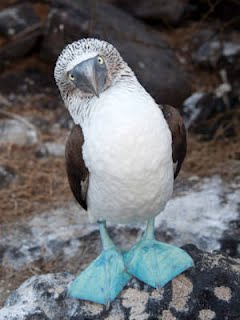
I am such a blue-footed booby.

Wednesday, May 16, 2012

Review: Adrift on the Sea of Rains

I don’t do a lot of reviews. But, well, Ian Sales’ first book of his promised quartet, Adrift on the Sea of Rains, is a dream. Not a dream, like teenyboppers called, with futility, Rock Hudson. Not a dream as in completely inconsequential. The book feels real even when you know it’s not. Reaching the end is like waking, with the sensation that you’ve somehow lived through something you haven’t. Adrift on the Sea of Rains is the exceedingly rare form of science fiction that tries to hewn very, very close to our current understanding of plausibility. Even the book’s farthest stretch – the torsion generator – is anchored in actual Nazi lore. The story follows a group of astronauts marooned on our moon. The technology at their disposal is, for the most part, stuff we could have been making for the last 30 years, had we not been more interested in credit default swaps and death. Ian’s technical acumen is compelling. ‘Adrift’ gives one a glimpse of world that perpetuated its space program, in a completely plausible manner. What sets this work apart is the not ‘what’ of space ventures, but the ‘why’. I don’t want to give too much away, but the plot wrestles as much with the reactive propellants and it does with political and personal ones. In the end, it portrays not just a space program that could’ve been, it grapples with why things couldn’t be. Lovely. And I’m now screaming for the next one. Like a teenybopper with a crush on Rock Hudson. If we can’t live the dream of manned space exploration, I’d like to read more about it.

Monday, May 7, 2012

Synch, Kiss Me, Drop

I became a fan of Susan Church in a writer’s least favorite way. I met her first (most writers want you to love them for their work). She’s such a delightful person I had to see if any of her charm came through her fiction. This is not a given. I’ve met some wonderful people who couldn’t write a check and some troglodytes with word skills beyond their social abilities. I am a total jackass, but my fiction is pretty engaging. Susan is one of the lucky bunch whose personality comes through the page (screen, more and more). Her newest story is here, and free, and great way to get started. She has a trippy way of getting across her trippy plot, puts you on the side of questionable characters and basically takes you to a world that doesn’t yet exist but you’re pretty sure probably could at any moment. And she makes you smile. An often overlooked, but damn good reason, to read.